Sunday, 5 July 2015

Born Again In Birmingham


THE NIGHTINGALES - MIND OVER MATTER

In my mind, there are two bands called the Nightingales, both from the Midlands and with a frontman named Robert Lloyd. The first one formed in 1979 from the remnants of the Prefects. They gained a cult following and recorded no fewer than eight John Peel sessions before Lloyd embarked on a new career with his backing band, the New Four Seasons. Then we have the 21st century Nightingales whom I see live on such a regular basis that I've come to regard them as friends, even though I've never spoken to Robert Lloyd. To be honest, I find him a tad intimidating - but then who wouldn't, with his towering frame and deadpan attitude? Admittedly their gigs can be shambolic - in an entertaining way of course - especially the infamous show at the Wagon & Horses last year with Lloyd swigging whisky to the point that he could barely stay upright, prompting me to confiscate his microphone stand before he hurt someone with it. But you always forgive friends for these minor indiscretions. When this incarnation (re-)formed in 2004 it was clearly intended to be a new project rather than to resurrect past glories, as can be seen from the setlists I've pilfered from the stage over the years. The only early song regularly played is "The Crunch".

Do you find that you never ask your drinking pals what they do at work? I'm the same with the Nightingales. I see them in small venues so often that their recorded output sits on my shelf untouched. When I think of their 21st century work it tends to blur into one long (albeit great) album. I'm expecting this one to slot in neatly with the others. Its title is a common three-word phrase as with previous releases ("For Fuck's Sake", "No Love Lost", "Insult To Injury") but there is a noticeable difference before it's even hit my turntable. Rather than the usual chaotic, colourful artwork by David Yates, I'm faced with a stark black sleeve showing what appears to be a scan of Robert Lloyd's brain. This sets the tone for something more inward looking than your standard 'Gales fare.

I wouldn't go so far as to call it soul searching but on some of the tracks Lloyd is certainly pondering his place in the world. On "Ripe Old Age" he talks of getting old and fat; on the 1950s-tinged "I Itch" he complains that he can't get comfortable, not just physically but with the reality he has to face on waking every morning. The introspection is most prominent on the self-parody "Gales Doc", where Lloyd takes the role of a journalist interviewing the band about their approach to songwriting. He mentions how the band often "go quieter and quieter two thirds of the way through the number while I mumble something over the top. Then I give them some kind of verbal or hand signal and they go loud again." How true. I've noticed them do this at least twice at every gig they've played. The journalist calls Lloyd arrogant for describing his band as "sonically more interesting" than others who just "knock off three-minute chunks". I suspect he is trying to pre-empt critics who have picked up on his boastful attitude, but it's also possible that he could be praising the variety on this album compared with previous 'Gales releases. The spoken word delivery reminds me of Half Man Half Biscuit numbers such as "Breaking News" or "Twenty Four Hour Garage People". In fact this is how I imagine Nigel Blackwell's mob would go about a Nightingales satire.

For me, the standout track is "The Man That Time Forgot", which at first seems to be the name of a film that went straight to DVD. But you begin to wonder if the man in question is Lloyd himself, and it's his own life and relationships with those around him that are falling into the void. Over a riff that Tony Iommi would envy, he finds himself in a pitched battle with drummer extraordinaire Fliss Kitson. She screams "You're talking but you're not saying anything" over every word he utters, turning it into what would have been Bikini Kill's best song. He tries to retaliate, saying he is always ready for a fight but eventually concedes "It's over, you got what you want." Kitson 1, Lloyd 0.


Anyone who has witnessed the band live will know that Kitson's drumming is probably the most ferocious you'll find on the circuit right now, but it's good to see her stepping up to the front as well. She gets a song of her own, "Stroke Of Genius", which along with the preceding "For Different Folks" manages to out-psych even Psychic TV. In fact all of the band make noticeable contributions, despite preconceptions that it's very much a vehicle for the frontman's dry sense of humour. Alan Apperley is the other member remaining from the original line-up, and alongside the aforementioned Sabbath riffing and his trademark surf guitar, he dishes up slabs of Gene Vincent and '70s glam. The whole thing is held together by bassist and producer Andreas Schmid, who has served time with Faust - a band who moved well beyond the confines of the Krautrock tag originally pinned upon them. He brings a similar approach to this album by pulling in influences from all over the shop without making it sound like a rehash of old ideas.

Incidentally, it would appear that since the recording of the album, Apperley has left the band. I'm not sure why or whether this is permanent but on the strength of recent gigs, Jim Smith (of Brum weirdos Betty & The Id) is a sterling replacement.

36 minutes seem to fly past in no time and as we approach the end, Lloyd's acerbic wit rears its head again in "Great British Exports", where he tries to list the things that made this country great. The best he can come up with is Mumford & Sons, "Midsomer Murders" and the slave trade. Is he suggesting that this record is the only great thing to come out of Britain? He's being arrogant again and in this case his swagger is justified. How many other bands can you name who split up, reform a decade later and then after a further decade release their best album?
Nightingales 10, rest of the world 0.


Monday, 25 May 2015

Indiepop Ain't Noise Pollution

BIRMINGHAM POPFEST - Hare And Hounds

Now in its second year, Birmingham Popfest is a weekend event admirably put together by Gavin Priest of indie band the Proctors. Although relatively low-key, there are a few well-known acts at the top of the bill, including some who you might not have realised were still around. Despite Birmingham's thriving music scene, many seem to think everything is centred around London so it's encouraging to see that fans have travelled from elsewhere in the country to attend.

I get to the Hare And Hounds early on the first day, expecting things to kick off at 5pm with the Tamborines. I have no idea who they are or what has happened to them but they are nowhere to be seen so I have nothing to do except have a drink until 6pm when the weekend gets started properly with Fever Dream. They sound exactly how I imagine a band of that name would sound - classic shoegaze in the style of My Bloody Valentine and true to form, the vocalist/guitarist spends most of the set hiding behind his fringe. There are some obvious melodies beneath the noise and towards the end everything goes a bit mid-80s Sonic Youth. As with most shoegazing, I have no idea what is being sung but the lyrics are probably pretty abstract anyway so I just let the waves of noise wash over me.

Fever Dream

Next up is Karen, featuring members of long-standing Bristol act the Brilliant Corners. I've assumed it will be a solo artist and I try to remember if the Corners ever had a female vocalist, but it turns out to be a band and as far as I can make out, none of the members are called Karen. I'm expecting something similar to the Corners' headline slot last year but I'm baffled at first when the opening songs bear little resemblance to the quirky songwriting of "Teenage" and "Somebody Up There Likes Me". Three songs in, when they announce that they're going to play a few break-up songs, I realise that this is something very different from their other band, and it's actually closer to the more morose aspects of the Auteurs. It is an enjoyable set, although afterwards I can remember few of the songs.

Karen

Many indie bands have generic names that are formed by simply taking two random words and sticking them together. As soon as Night Flowers have finished their set, I forget what they were called as there are so many bands with "night" or "flowers" in their name. They are the first real indiepop band of the weekend, with some nice guitar lines and twee vocals, and in case it isn't already clear where they're coming from, the singer smiles a lot and shakes a tambourine. Unfortunately the drums are a little too powerful and drown out the gentler elements. Eventually things even out as everything becomes more noisy but although I enjoyed their set I would have preferred to hear more of the prettier parts. If they can balance out the sound and come up with a more memorable name then Night Flowers do have potential.

Night Flowers

Saturday's highlight for me is the collaboration between Pete Fij (formerly of Adorable) and Terry Bickers (The House Of Love/Levitation). I hadn't realised that they'd been working together so I have no idea what to expect, whether it will be songs from their respective bands or something new. Apart from one Adorable song and a Spacemen 3 cover, the set is drawn from their album "Broken Heart Surgery". The contrast between Pete's gently strummed acoustic guitar and Terry's elaborate Durutti Column-inspired electric playing is phenomenal. The songs are moving but nothing has prepared us for the climax. Pete dedicates the final number to his father, who had died the previous week. The whole room falls silent as he delivers one of the most emotional performances I've seen. He just about makes it to the end then politely says his goodbyes and moves to the side of the stage. Once he's composed himself I have a long chat with him about such wide-ranging topics as his approach to songwriting and the recent scandals involving Dave Lee Travis and others. He's clearly a very intelligent man and I wish I had listened to the album sooner.

Pete Fij and Terry Bickers

As headliners the June Brides take to the stage I realise that despite their cult status, I'm not that familiar with their work. I have a compilation of their 1980s singles but I can't remember when I last played that. Apart from their best-known songs "No Place Called Home" and "Sick, Tired and Drunk", I recognise little of tonight's set and I actually feel slightly guilty about this. I'm coming to realise that it's insane to attempt to hear every band that fits into my usual style of listening so I manage to make the most of the June Brides' set despite my lack of acquaintance with the songs. As you would expect from the lead band at such an event, they have a recognisable jangly guitar sound but it's the addition of violin and trumpet that makes them stand out. I would like to give their songs a better listen and then maybe see them live again, but I still feel that the first night has been rounded off in style.

The June Brides

I arrive on Sunday to find that the running order has been shuffled slightly to make space for the Tamborines. But there is no sign of them. Again. I'm starting to doubt that they actually exist. The afternoon eventually gets going with an Italian (I think) going by the name of Morning Tea. At first this seems an odd name for a performer but it does suggest something very relaxing, which sums up his sound pretty well. It's reminiscent of Sufjan Stevens at times and the tales of regret over things that could have been reflect what usually goes on in my head while I'm drinking my morning tea.

Morning Tea

Next up is another solo artist, a Scotsman called Paul Tierney or Lonely Tourist as he prefers to be known. At first his guitar playing reminds me of early Billy Bragg, although his songs are not especially political. It's not until the second song that I notice his Scottish accent and I immediately think of Ballboy. (Are they still in operation? I hope so.) His accent is such that I don't know what all of the songs are about, apart from one about finding a footballer who shares his name. I should really have bought his album to find out more but I always come away from these events with too much to listen to anyway.
Lonely Tourist

I've seen some people sitting in the bar downstairs, all hair and sunglasses and leather jackets, and I know they have to be the Manhattan Love Suicides. They follow the tradition of the Primitives, Flatmates etc. and use sixties girl group-influenced vocals over buzzsaw guitars. But the vocals are sugar-coated barbed wire and the seemingly sweet songs have titles such as "Never Stop Hating You" and "She's A Bullet". The guitars could have come straight from "Psychocandy" and, dare I say it, the sound seems louder than when the Jesus And Mary Chain toured that album recently. Such is the ferocity that after three songs the bassist has lost his sunglasses and his perfectly groomed quiff has fallen into his eyes. I obviously need to give him some tips on hair products. Bands like this typically self-destruct within six months so catch them while you can.

The Manhattan Love Suicides

It's well known that I'm a big fan of Desperate Journalist, in fact they were responsible for my favourite release of last year. But when you're so enamoured with a band it's often difficult to describe them in a way that will convey what they actually sound like. Tonight they're playing on the biggest stage I've seen them on so far. It may just be due to the increase in volume but they seem much angrier than usual. It strikes me that what we have here is four very different people, which could explain why it's so hard to describe what happens when they come together. Rob Hardy's guitar sound brings to mind classic post-punk acts such as the Bunnymen, although tonight he attacks his instrument with such force that I wonder what it's done to upset him. You could usually imagine Jo Bevan fronting a pre-Britpop '90s band but tonight she too seems irate about something and her delivery borders on "riot grrrl". Caz Hellbent, as always, sits at the back channelling the spirit of Keith Moon. Bassist Simon Drowner is relatively restrained but I suspect that's because he has a lot going on inside his head. He could have stood in for Richey when the Manics toured "The Holy Bible" recently. If that description leaves you any clearer as to what the band sound like then I've obviously underestimated you. If not then your best bet is to head over to their bandcamp page and listen for yourself.

Desperate Journalist

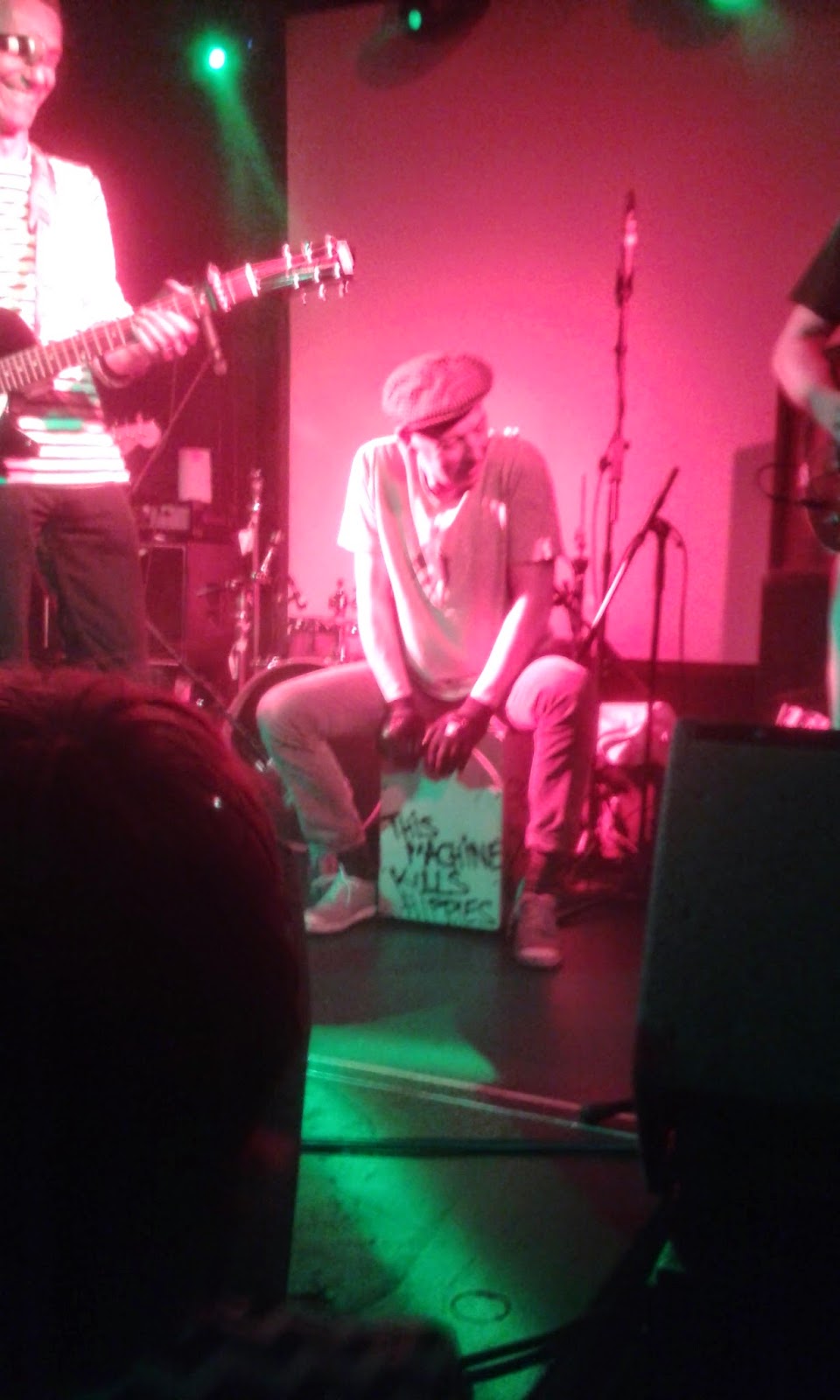
Bob were always one of those bands who (to me at least) seemed to be better known for their t-shirts than their records. Back in the late '80s their red, white and blue logo was everywhere but I don't recall hearing their music. It's only in the last few years with a compilation of their singles becoming available that I've become familiar with their songs. So I'm surprised to find that they have such a dedicated following and that many people, including one of my friends, have come along specifically to see them. To a certain extent I get what I'm expecting, indiepop that characterises a specific era, but there is some scratchy guitar that takes me by surprise - something that could easily have been found on a Postcard release from many years prior to Bob's original incarnation. The percussionist tonight is playing what I believe is called a cajón. OK, it's just a wooden crate but it's still very effective. Songs such as "Convenience" and "Trousercide" get the crowd moving, with Bob delivering the most rousing set of the weekend.


Bob

Sunday night headliners the Primitives are usually remembered for one song. I'm sure I don't need to name it and I can't deny that it's one of the best singles of the 1980s, but there's a lot more to their back catalogue that is often overlooked. Their recent album "Spin-O-Rama" perfectly captures the post-C86 sound (I guess that would be C87?) and several songs from that record get an airing tonight. Most of all it's great to hear the other 1980s singles "Really Stupid", "Stop Killing Me" and "Thru The Flowers". Of course they also play "that song" but it's a very subdued rendition, as though they are desperate to take the focus away from it. There are criticisms from some in the room that it's just style over substance and I can see their point; the show is very much about Tracy Tracy, who is so small and sparkly that she wouldn't look out of place atop a Christmas tree. The way she twirls around and playfully reaches out to those at the front means that few people notice what the rest of the band are doing. Sure, it's a bit frivolous but it's a cheery way to end a weekend that has showcased a variety of styles.


The Primitives

I've noticed that when describing the weekend's performers I've compared most of them to other acts. This is simply because I've been going to gigs for so long that it's rare to find something that sounds truly new. But I've come to realise that this shouldn't be a problem. If you enjoy a particular sound then it's fine to embrace new acts playing in that style rather than criticise them for being unoriginal. Overall this was a very successful event and I hope Gavin can put together another varied line-up for next year. But the main lesson learned is probably that if you see a gig by the Tamborines advertised, don't count on them showing up.

Sunday, 17 May 2015

Never Lose That Feeling


SWERVEDRIVER - Birmingham Academy 2

In the early 1990s, there was a relatively short-lived scene that journalists christened "shoegazing", due to the performers' habit of staring at their feet (or, more likely, their guitar pedals) rather than interacting with the crowd. I've mentioned many times on this blog that genre names can be unhelpful but shoegazing is an exception. I can easily define the sound and name the associated bands. They may not have been at the time but retrospectively, Oxford's Swervedriver are frequently mentioned alongside other acts who were part of the shoegaze culture. However, I'm not sure that this classification is entirely accurate. Although they used distortion and reverb effects, Swervedriver resided at the heavier end of the scale, and were more at home with US contemporaries such as Dinosaur Jr. Rather than hiding behind floppy fringes, they sported dreadlocks and they eschewed the ethereal lyrics of other shoegazers in favour of a road movie theme with pickup trucks and classic cars.

17 years since their last album, they are back and although the approach has matured, much of the intensity and lyrical themes remain. With the dreads gone, Adam Franklin could still be in an American film but with his cap and beard he now resembles a trucker, driving with a defined aim rather than for pure adrenalin. The songs from new album "I Wasn't Born To Lose You" take the sound that had started to develop on 1998's "99th Dream" and push it a little closer to classic shoegazing, with the chiming guitars calling to mind fellow Oxford band Ride. The songs are still about travel but there is a new-found desire to take in the scenery. We are clearly revisiting old haunts - the lyrics of "Everso" slip in a sly reference to classic single "Son of Mustang Ford" - but now the focus is on more than just getting the maximum power out of their engines. Tonight's opening number "Autodidact" talks of "a dimension of beauty mobilised within my head". I like to think that this blog follows similar lines - rediscovering loud records of the past but finding previously unnoticed subtleties beneath the volume.

The subtleties are apparent tonight because the sound is spot on. I've recently complained about the acoustics in certain local venues, but I find that smaller gigs often have better sound quality; with the crowd closer to the stage there is no pressure to crank everything up to 11. A powerful experience can still be achieved without sacrificing intricacy and as we stand by the speakers tonight, striking distinctions can be heard between each band member's contribution. Unlike many shoegaze acts, Adam's vocals are clear and the interplay between the fuzzy layers of guitar and more complex elements can be made out in a way that I would only expect when listening through headphones.

The problem with Friday night gigs is that they are often poorly attended as everyone prefers to head straight to the pub. Personally I prefer to be at a show that's not sold out, as I can get can close to the stage and even take a few photos without being crushed. But it's hard not to feel for an artist playing to a room not even half full. Swervedriver seem unfazed by this, though, as do the appreciative few who have shown up tonight. Of particular note is the chap in front of me with a lumberjack shirt over his Sonic Youth "Goo" t-shirt, flailing his long hair to old favourites such as "Rave Down" (with its gas station hell and "sharp hard hit of a car crash in a dream"), "For Seeking Heat" ("...a blur of beauty, intoxicating"), and of course "Son Of Mustang Ford" ("hallucinogen headlamps, my sane scape's disrupted in a pickup truck"). As much as the music itself, the presence of this one fan fills me with nostalgia. He doesn't want to forget the past, and why should any of us? Even if we have expanded our viewpoint beyond sheer speed, let's go out with one final blast of power. The evening closes with 1993 single "Duel", and its opening line "You've been away for so long, you can't ask why." Rather than ask why, let's just embrace this welcome return. As I leave clutching a beautiful splatter vinyl copy of "I Wasn't Born To Lose You", my one regret is that I hadn't bought the record sooner. Even before I've unwrapped it, on the strength of tonight's show I am certain it will be one of the top albums of 2015.

Tuesday, 28 April 2015

Boys Keep Swinging


LOUIS BARABBAS - Birmingham Tower of Song

As Louis Barabbas takes to the stage looking like he's just stepped out of "Peaky Blinders", I wonder how he came to be here. He is a man from another time and place. You could be forgiven for thinking that he's some retro hipster but it's soon clear that he is the real deal. Sure, the sound on his records with backing band the Bedlam Six - a mix of vintage swing and vaudeville cabaret - is not a million miles away from what certain other acts have done relatively recently. The Tiger Lillies are an obvious example. Add in the gypsy guitar that's prominent in his solo set tonight and older listeners might be reminded of Marc Almond's 1980s project, Marc and the Mambas. But while those artists borrowed from the past, you get the sense that Louis Barabbas was actually around during that era. By some strange freak of space-time, he seems to have influenced those acts who came before him.

Louis no doubt started out playing in a 1930s swing joint, but his glorious chaos would have been too much for the hepcats of the day. They went to those clubs to have fun and jive their cares away. They didn't want to hear about jealousy, revenge and a young child crucifying her pet cat. They would have chased him from the club with such anger that he had nowhere to run except into the 21st century, passing through 1977 to pick up a bit of punk spirit on the way.

And now he finds himself in an illicit backstreet whisky den playing to a small crowd who also feel at odds with the era in which they are living, so are more appreciative of his gritty tales. Despite the dark humour contained within, the music is upbeat and to call his performance energetic would be an understatement. The stage is too small to contain him and he expresses concern that his high kicks will knock over his drink. But that's the least of his worries. His jerky movements suggest a man who is constantly on edge, afraid that at any moment his nightmares are going to catch up with him.

There is a recurring theme of escape, particularly in the songs from the latest album, "Youth". During "The Debtor's Wife", he asks "Won’t nobody help me get out of this hole?" But ultimately we have to find our own way out, which becomes clear in standout song "Year Of The Bitch", where he talks of packing up his life and taking it to the tip. I'm sure you've often considered doing that but Louis has the courage to go through with it. And I suspect he has, judging from the song "Mother", where he confesses that "There’s a stranger in this mirror or is it just stained glass? I’ve changed my face so many times, I wish I could change the past." I feel that I must make the most of this fleeting display of genius before his past life kicks down the door and again causes him to flee.

Regular readers will know that here at Rebellious Jukebox we don't like to pigeonhole music. Louis is sympathetic to this. "Genres?" he asks, "What's that all about?" before announcing that he's going to play a soul song. By which he means that "Let Me Down Slow" is slower than the preceding numbers, but with more shouting to compensate. If he played this in a soul club then he would also be chased out. This is a one-man mission to smash the very concept of music genres. If you come away from this review none the wiser as to what he sounds like then he's obviously succeeded in his mission.

If the universe played by the rules then Louis Barabbas wouldn't exist in 2015. Thankfully, rules are there to be broken.


Sunday, 12 April 2015

Papa Was A Rolling Stone


SUFJAN STEVENS - CARRIE & LOWELL

I've always found the music of Michigan songwriter Sufjan Stevens to be comforting but up until now I've never been sure why. His folk-pop albums, especially "Seven Swans", are beautiful but I've lost touch with him over the past few years as his work has gone off on a tangent. After two experimental records, Stevens has returned to his folk roots and his time in the electro-orchestral wilderness has strengthened him. "Carrie & Lowell" contains his most stripped-down sound to date with the plaintive guitar backed by a supporting cast, including Laura Viers, although their contributions can easily go unnoticed until the third or fourth listen. But in contrast to the fragility of the music, emotionally these are some of his most powerful songs and it suddenly becomes clear why I have always found such a feeling of warmth in his work.

Put simply, Sufjan Stevens reminds me of my dad and of his record collection that was a constant presence in our house during my childhood. Particular reference points are Simon and Garfunkel, or more delicate Beatles moments such as "Blackbird" or "Norwegian Wood". But most of all, these are the kind of songs that my dad would have written had he been a musician. On previous albums, Stevens has cunningly woven autobiographical elements into tales of fictional characters, and there was never a clear border between the two. Similarly my father would regale us with tales of his life, mostly untrue but the aim was to entertain rather than deceive. He clearly dreamed of being a performer and told us stories of his fictitious music career; he even convinced my sister that he had once been in the Beatles. In reality his musical ability was sadly limited, as is mine. So we have both had to settle for basing our writing and storytelling around the creativity of real performers.

Although there are moments here that are almost certainly fictional, Stevens has produced something that is rather more personal than previous efforts. The people in the title are his mother and stepfather; the album tells of the former, who left when Stevens was a child. He recounts memories of her but as his time with her was limited to the occasional holiday it's likely that many of these are pure fantasy, his idea of what a real childhood would be like. Again, I can imagine my father writing songs about the strained relationships with his own parents and siblings; the difference being that those songs would likely have been full of sarcastic humour (another trait he shared with me) while the songs on "Carrie & Lowell" display a touching sense of forgiveness. After seven albums, it seems that Stevens has finally found the confidence to be truly open with his audience.

The nakedness of the instrumentation here means that there is actually very little that I can say about it. Any attempt at a description would be similarly sparse so instead, I encourage you to listen to the album and, hopefully, purchase it. For me, there is nothing like unwrapping a physical album and reading the lyrics for the first time so I strive to avoid hearing new songs until the product is in my hands. Those of you who don't share my old-fashioned perspective might choose to listen to the full album stream that is available below. Whether you see parallels with your own upbringing or simply immerse yourself in the singer's own story, you cannot fail to be moved.

Monday, 9 March 2015

You Should Always Keep In Touch With Your Friends


THE WEDDING PRESENT - THE HIT PARADE

Back in 1992, the Wedding Present embarked on the ambitious venture of releasing a 7" single each month for the whole year. They were already hated by the music press and this project, deemed self-indulgent by many, did nothing to help their cause. But journalists' opinions have never mattered and the singles became very collectable. You might expect me to have been among those who collected them, but this was during the brief period when I only had a cassette player and my vinyl buying was minimal. The 24 tracks from the singles have now been compiled on a CD with all kinds of bonus material so it seems that a bit of re-evaluation is due.

In my late teens, the songs of the Wedding Present described my life more accurately than anyone apart from the Smiths. On the albums "George Best" and "Bizarro", David Gedge's words were full of anger and bitterness. His frantic guitar mirrored the speed of a typical relationship. Nought to break-up in three minutes. On the following album, the Steve Albini-produced "Seamonsters", the mood shifted from bitterness to resignation and this was reflected in the one-word song titles, in contrast to the lengthy names given to earlier tracks. "The Hit Parade" sees Gedge moving on with his life. There is more variety in the lyrics, although the general theme of relationships is continued. This was the point when my own relationship with the Wedding Present started to fall apart, and in the years that followed, Gedge's life moved on further and he began to seem like one of those friends whom you lose touch with after they get married and start a family. You feel pleased for their happiness but you no longer have anything to talk about. The late '90s albums sit in my collection like a number in an address book that I'm not even sure is up to date. Maybe I should rekindle my friendship rather than scribbling David Gedge's details out of my book.

The accusation "all the songs sound the same" was often levelled at the band, to the extent that they adopted it as a battle cry and I even had a t-shirt bearing the slogan. But these singles didn't all sound the same and looking back, it was the shock of this unfamiliarity, the variation from what I had come to trust, that disenchanted me. Older and wiser, I can see that this variety was essential or they would have stagnated. Having said that, listening to the tracks for what is probably the first time this century, I'm surprised to find that some are not as different from the earlier albums as I thought at the time. The vocal delivery is not as intense and although the guitar is toned down, much of the abrasiveness is still there. "Come Play With Me" and "Silver Shorts" in particular do sound comfortingly familiar. To a certain extent I must still be set in my ways because the peak for me comes halfway through the year with the most Wedding Present-like song. July's single, "Flying Saucer", eclipses everything on "Seamonsters" and finishes with an extended guitar workout reminiscent of the epic "Take Me" from "Bizarro". "Flying Saucer" is possibly the last classic Wedding Present song, but I've always said that about "Dalliance" from the previous album so maybe there is something of value to be found in the even later works.

Each new song was backed with a cover version and there are some inspired choices that in many cases outshine the song on the A-side. There are cult favourites from the likes of the Go-Betweens and the Close Lobsters, and a surprising take on the Monkees' "Pleasant Valley Sunday" that comes closer to the magic of the original than I would ever have thought possible. The less predictable covers are film and TV themes ("UFO", "Shaft") and the standout of these, in fact probably the best of any of the 24 songs apart from "Flying Saucer", is "Falling". You would be forgiven for thinking that it is the version used in "Twin Peaks" until the vocals come in. Then the sound becomes so different from Julee Cruise's original that the effect is startling. This, combined with lyrics ("Don't let yourself be hurt this time") that could have been penned by Gedge himself, makes for a surreal experience and you wonder if you have woken up in David Lynch's nightmare world.

As with most "expanded" reissues, some of the extras are not strictly necessary. The 80-minute live set is worth hearing but do we really need 20 alternate takes and radio session tracks that barely differ from the 7" versions? The sequencing of disc 2 even means that we get two similar versions of "Silver Shorts" in succession. Obviously someone thinks this is a good marketing idea but despite my reputation as a collector, I rarely buy reissues just for different versions of songs I already have.

As if recording two songs a month wasn't keeping them busy enough, the lads also made a video for each new song and these are included, under the collective name of "Dick York's Wardrobe". These are proof, if you needed it, that indie bands should not make pop videos. They were obviously having a laugh but these are uniformly dreadful. In particular, I would advise against watching "Loveslave", as the image of the band in nappies and glittery wigs is not something that you will ever be able to erase from your mind.


When the singles came out I was such a staunch indie kid that I had sworn off all mainstream media and had no idea what was in the charts. They must have done pretty well though as there are no fewer than four "Top Of The Pops" performances included here. These are followed by a recent interview with David Gedge where he reflects on the recording sessions. I can't help but notice that he's starting to resemble Tony Blackburn and I wonder if this is what becomes of us all when we move on in life. Maybe I'll stick to anger and bitterness.

If you're not familiar with the Wedding Present at all, you should start with the albums "George Best" and "Bizarro" then work your way through the others until you get to the point where David Gedge's life seems to be taking a different path from your own. For those of you who are old friends but found your paths diverging 20 years ago, this would be a good time to reacquaint yourselves.

Sunday, 1 March 2015

Noise Annoys


THE JESUS AND MARY CHAIN - Manchester Academy / Birmingham Institute

The choice of venue can often make the world of difference to the success of a gig, even with the performers giving it all they've got. This is painfully apparent when I compare these gigs that I saw a few months apart, with exactly the same set being played in two different locations. When the Jesus And Mary Chain announced three dates at the end of last year where they would be playing their 1985 debut in full, there was much excitement and a group of my friends immediately snapped up the maximum number of tickets for one of the shows, even before we'd worked out if there were enough of us to use all of them. With tours such as this, with only a handful of dates, it's likely that a longer tour will be scheduled soon afterwards and usually with a show closer to home, but if this means I get to see the band twice then so be it.

I'll start by reflecting on the Manchester show back in November, as I didn't write about it at the time. When a favourite band returns from a long break, particularly when playing a classic album that I was too young to hear played live the first time around, there's always the fear that it won't live up to expectations. In this case there was no need to worry. Before the full run-through of the album, we're treated to seven other songs from various points of their career - playing the encore first, as frontman Jim Reid puts it. They kick off with the jangly "April Skies", perhaps the song that most appeals to those who can't quite decide if they like the band or are put off due to their noisy reputation. Then there are a couple more almost-hits - "Head On" and "Reverence", plus the single "Some Candy Talking" from the same time as the album and the song "Psychocandy" itself, which confusingly didn't appear on the album. An unexpected and welcome inclusion is "Up Too High", an early song that was never released until it appeared on a collection of b-sides and demos in 2008. The first part of the show ends with the debut single "Upside Down", to prepare us for the discordant glory that's coming soon.

Then the volume is cranked up to 11 and even beyond, and we're reminded why "Psychocandy" was such a groundbreaking album. There are melodies here that are easily discernible alongside the wall of fuzz and some great singalong moments, including the gruesome motorbike crash of "The Living End", and "The Hardest Walk" - quite possibly the best break-up song ever. Jim is still a compelling performer, while his brother William stays in the shadows. Some have cruelly said that he's chosen to stay out of the limelight because he knows that he no longer looks as young as he used to, but he's retained his mountain of curly hair and seeing this silhouetted through the smoke, we could easily be back at one of their classic '80s shows where they never looked at the audience. William's guitar is very precise in its distortion and the trademark sharp feedback comes at exactly the right moments. Ex-Lush man Phil King adds an extra layer, not present on the original record but this only serves to make things more cohesive. This is one of the loudest gigs I've seen for a while but despite the volume there is clarity and we're left in no doubt as to what's going on behind the strobe lights.

If I have one quibble, it's the inclusion of a full drum kit. I'm very aware that the Mary Chain used "proper" drums in the final years of their original incarnation, but one of the key elements of "Psychocandy" is Bobby Gillespie's sparse drumming. Obviously Bobby has other things to be getting on with now, but I'm sure if they'd advertised then they would have found someone who couldn't play any more than two drums. I could easily get sidetracked into listing the host of great bands using this style of percussion, but let's just say that pretty much anything - doing the washing up, watching Jeremy Kyle - can be rendered life-changing by the addition of a stand-up drummer.


But I can't really complain about the absence of Bobby as the gig is still more exciting than most young bands I've seen over the past year. We leave the show feeling electrified that something 30 years old still sounds so fresh.

Three months later and I'm excited about seeing the same thing all over again, although I am a little cautious as the Institute has never been one of my favourite venues. I have attended gigs there where everything has sounded spot-on, but an equal number where the sound has left a lot to be desired. I've never been sure if this is because the shape of the room leads to poor acoustics, they've skimped on the sound system or maybe even the sound engineer himself isn't up to scratch.
Things don't seem too bad at first as the band blast through the same seven songs as at the Manchester show. The sound quality isn't perfect but at least things are reasonably clear and it's better than some gigs I've seen in this venue. But once the "encore" is over and we get to the album, things start to go wrong.
My best guess is that the soundman has never actually heard "Psychocandy" but is aware that it's full of distortion so decides that the best option is to push every one of his sliders to the top. This means that it's difficult to discern the separate elements of the music. William's shrill feedback is barely noticeable, all we get is a muddy pool of gloop. It becomes so murky that at one point I lose track of the songs. Despite the album being played in order and the fact that I can recite the tracklisting in my sleep, we're halfway into "Never Understand" before I realise which song it is.

The evening isn't a total loss and I do enjoy hearing the songs again, when I can work out what they are, but I get the feeling that if I had just seen this show and not the previous one then I would think that the band had lost their edge. Indeed, this is the opinion of a friend who is seeing them for the first time in 20 years.

I'm not sure if there are any long-term plans for this reunion, either new songs or more gigs, but I'm glad I got to see one more fantastic show from them and I'll try to forget about the second one. As with many things in life, great moments seem even better when you've got something rubbish to compare them with.